Real world treatment patterns and outcomes for hepatocellular carcinoma (HCC) patients receiving transarterial chemoembolization (TACE) or transarterial radioembolization (TARE) in the TARGET-HCC registry
Challenge
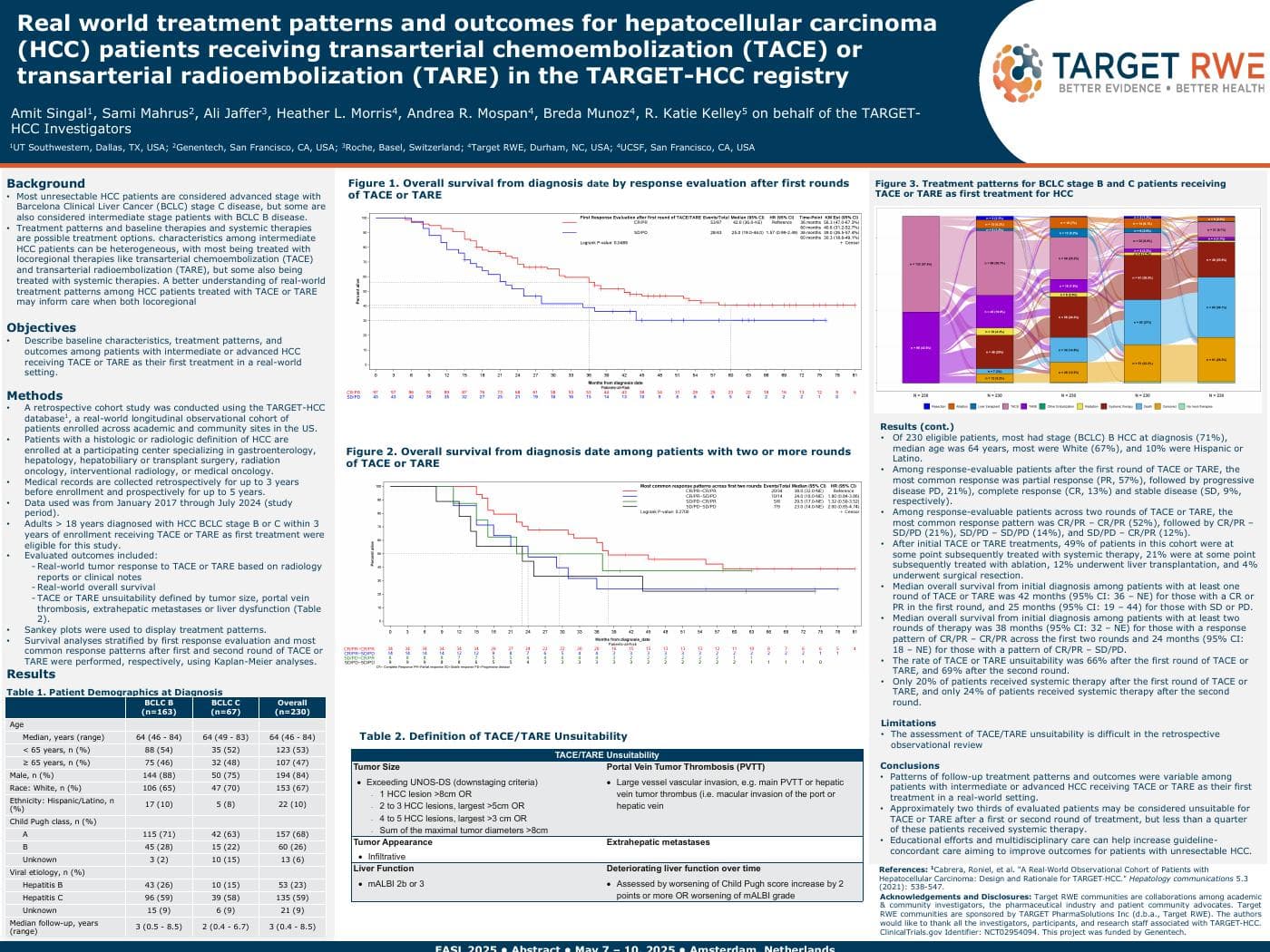
Intermediate-stage HCC patients receiving TACE or TARE represent a large and heterogeneous population, but real-world data on response patterns, suitability for re-treatment, and subsequent treatment sequences—particularly the transition to systemic therapy—were lacking, limiting treatment sequencing guidance.
Solution
The TARGET-HCC registry was used to analyze response to first and second rounds of TACE or TARE, TACE/TARE unsuitability rates after each round, treatment sequences following locoregional therapy, and overall survival stratified by response pattern in a retrospective cohort study.
Impact
Demonstrating that two-thirds of patients become unsuitable for continued TACE or TARE after a first round—yet fewer than a quarter receive subsequent systemic therapy—identifies a significant treatment gap and informs the evidence base for sequencing locoregional therapy with systemic agents in HCC.
Use Cases / Links
Real-world HCC treatment sequencing analysis for intermediate-stage clinical program design, TACE/TARE unsuitability and systemic therapy transition characterization, Locoregional-to-systemic therapy sequencing evidence supporting HCC combination treatment development