Determination of Optimal Thresholds for Significant Fibrosis in NAFLD Using Non-Invasive Tests from TARGET-NASH Study
Author: Andrea R. Mospan
Challenge
Standard FIB-4 and APRI thresholds for advanced fibrosis were derived from clinical trial populations, not real-world NAFLD cohorts, leaving uncertainty about whether the same cutoffs performed optimally in a heterogeneous real-world population with the full spectrum of disease severity.
Solution
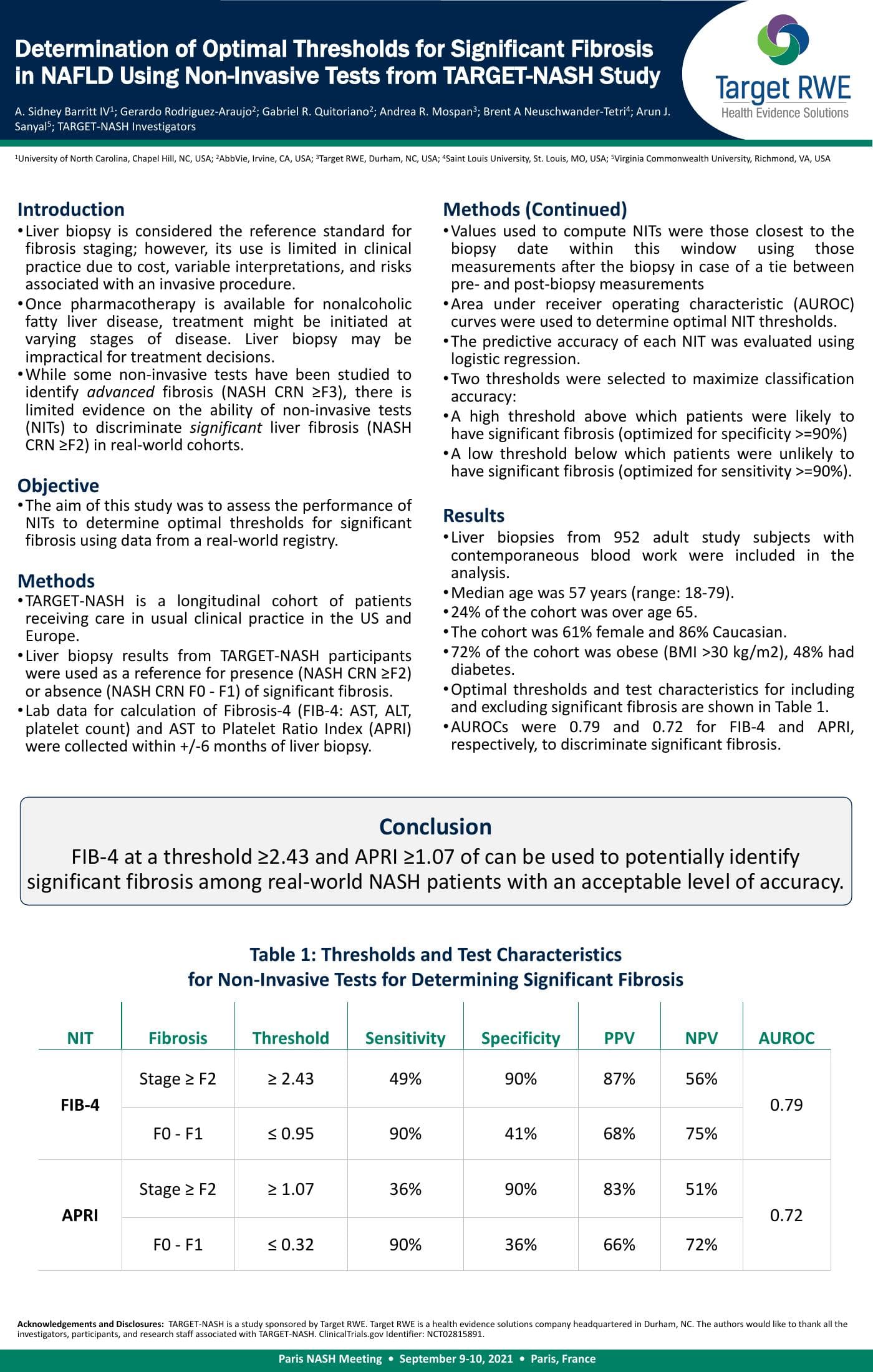
The TARGET-NASH cohort was used to derive optimal NIT thresholds for significant fibrosis (≥F2) using AUROC analysis against locally interpreted liver biopsies, generating high-specificity and high-sensitivity cutoffs for FIB-4 and APRI in a real-world population.
Impact
Providing real-world-derived optimal NIT thresholds for significant fibrosis in NAFLD enables more accurate patient identification for clinical trials targeting early-stage disease and supports the development of NIT-based enrollment enrichment strategies.
Use Cases / Links
NIT threshold optimization for NAFLD significant fibrosis identification in real-world populations, Non-invasive fibrosis cutoff validation for trial enrollment and clinical decision support, Real-world biomarker performance benchmarking for MASLD screening programs